
What Is the Best Antique Dressing Table Style in 2026?
Choosing the best Antique Dressing Table style in 2026 means balancing character with everyday use. Victorian examples bring carved details and generous storage; Edwardian designs often feel lighter, while Art Deco pieces add geometric lines and polished surfaces. Mid-century dressing tables can suit smaller rooms, though many are vintage rather than strictly antique. The right choice depends on your room, routine, and the condition of the individual piece—not a trend alone.
Market context helps, but it needs careful reading. The 2024 U.S. Houzz & Home Study reported a median renovation spend of $24,000 for projects completed in 2023, up from $22,000 in 2022. That figure covers home renovations broadly; it does not measure antique furniture sales. 1stDibs’ annual Interior Designer Trends Survey offers another useful view of professional design preferences, but a survey cannot predict what will work in every home. Details matter. Before buying, check the table’s width, drawer movement, mirror stability, finish, and any visible repairs. Look closely at joints and the back of the piece, too. A beautiful silhouette can still be awkward beside a narrow doorway or modern chair. This guide compares leading styles through those practical details, along with craftsmanship, provenance, and visual appeal. Some old pieces need more care than expected. That is part of their appeal—and sometimes a reason to pause.
What Defines an Antique Dressing Table Style?
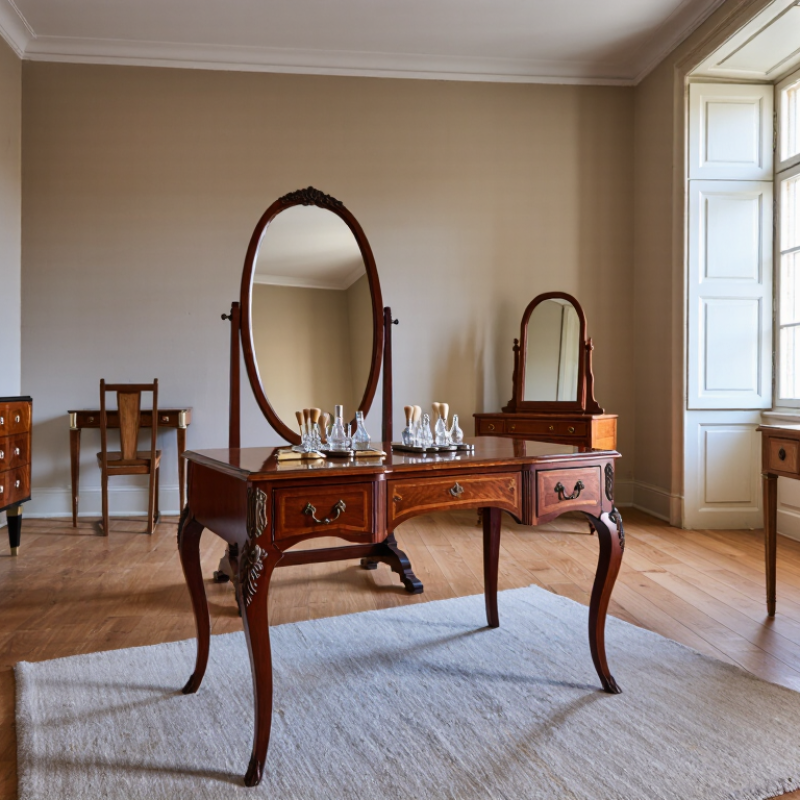
An antique dressing table’s style is defined by its period, shape, materials, and decorative details—not age alone. Look at the legs, drawer fronts, mirror frame, and hardware together. A bowed front, cabriole legs, and carved feet suggest a different design language from straight lines and restrained ornament. Wood grain matters, too. Walnut, mahogany, and oak each create a distinct visual character.
Construction offers useful clues. Check how drawers fit, how joints are made, and whether the mirror appears original to the table. Handwork may show small variations. That is not proof of age, though; later repairs and reproductions can confuse the picture. I sometimes find a worn finish more appealing than a flawless one, but wear can also hide damage. Patina should invite closer inspection, not replace it.
Tips: Photograph the table from the front, side, and underside. Note its dimensions and any maker’s marks. Compare several details before assigning a style, and ask a qualified furniture specialist when the evidence is unclear. A little uncertainty is honest. Don’t force a label.
Which Historic Styles Are Most Common?
Among antique dressing tables, Victorian, Edwardian, and Georgian examples are commonly encountered, but no reliable industry dataset ranks them by sales or surviving pieces. Auction and museum catalogues show recurring features: Georgian tables often have restrained lines and practical drawers; Victorian examples may pair carved wood with marble tops and large mirrors; Edwardian pieces tend to look lighter, with slimmer legs and simpler ornament. Art Nouveau and Art Deco designs also appear, though their curved or geometric details can make them easier to identify at a glance. That distinction matters.
Grand View Research’s 2024 furniture-market analysis estimated the overall global furniture market at US$736.2 billion in 2023. That figure covers furniture broadly, not antique dressing tables or historic styles, so it cannot prove which style is most common. Treat style rankings as informed observations, not measured fact. When examining a piece, check the mirror fittings, drawer construction, joints, and wear beneath the finish; these clues can reveal repairs or later alterations. A polished surface can mislead. I would not date a table from ornament alone: makers borrowed motifs, and some pieces combine periods in ways that resist neat labels.
What Is the Best Antique Dressing Table Style in 2026? — Which Historic Styles Are Most Common?
A practical comparison of widely recognized dressing-table styles. “Typical availability” is a general guide, not a measured market ranking; it varies by country, condition, and local supply.
| Style | Approximate period | Common identifying features | Typical availability | A good choice if you want… | What to check before buying |
|---|---|---|---|---|---|
| Victorian | 1837–1901 | Often substantial in scale, with carved or turned details, dark woods such as mahogany or walnut, and sometimes a marble top or a large mirror. | Often encountered in antique furniture listings and shops, though design and condition vary considerably. | A decorative focal point with generous storage and a traditional appearance. | Check mirror condition, drawer movement, veneer, marble for cracks, and whether later repairs are sound. |
| Edwardian | 1901–1910; the style is sometimes discussed more broadly through the years before the First World War. | Generally lighter-looking than many Victorian examples, with slimmer proportions, inlay or restrained ornament, and sometimes an oval or multi-panel mirror. | Commonly encountered, especially compared with more specialized styles; exact availability depends on the local market. | A comparatively light, versatile antique that can suit both traditional and understated interiors. | Inspect inlay and veneer for losses, test the stability of slender legs, and check mirror plates and fittings. |
| Georgian | 1714–1830 | Forms vary across the long period. Examples may have a compact writing-table-like body, drawers, cabriole or straight legs, and a separate or smaller mirror. | Available, but early examples and pieces with strong documentation or exceptional condition can be harder to find. | An earlier historic look, refined proportions, and a piece that may also work as a small desk. | Ask about age and restoration; examine joints, feet, drawer construction, and any replacement mirror or hardware. |
| Art Nouveau | Approximately 1890–1910 | Organic curves, flowing outlines, and nature-inspired ornament are characteristic of the movement; materials and decoration differ by maker and region. | Less routinely encountered than broad Victorian or Edwardian forms in many general antique selections. | A distinctive, sculptural design with a more expressive, nature-inspired look. | Look closely at curved or carved details, the condition of any decorative inlay, and the stability of the mirror frame. |
| Art Deco | Mainly the 1920s and 1930s | Geometric shapes, symmetry, stepped forms, and polished or figured veneers are common visual cues; designs vary widely. | Often represented in vintage and decorative-arts markets; availability of genuinely early pieces varies by region. | A more streamlined look with bold geometry rather than traditional carving. | Confirm the construction and date where possible, and inspect veneer, lacquer or polish, mirror edges, and replacement parts. |
Quick guide: For a widely adaptable traditional choice, consider Edwardian. For a more ornate, substantial presence, consider Victorian. “Best” depends on fit, condition, authenticity, storage needs, and the room. Period boundaries and style labels are approximate; Art Deco pieces from the 1920s may meet a 100-year definition of antique in 2026, while many later examples are more accurately described as vintage.
How Do Their Designs and Features Compare?
The best antique dressing table depends on how you use it, not just how it looks. Victorian examples often feature carved legs, dark wood, and large mirrors, creating a formal focal point. Edwardian and Art Nouveau designs tend to feel lighter, with slimmer frames and softer curves. Art Deco tables favor geometric lines and striking veneers, while later mid-century pieces usually offer simpler shapes and less ornament. That matters.
Their practical differences show up in the details. A Victorian table may provide several small drawers, but its deep finish can make a compact room feel crowded. An Art Deco design can look streamlined, yet its mirror angle or shallow storage may not suit daily grooming. Check drawer movement, mirror stability, veneer condition, and whether the table height works with your chair. Measurements help; photographs can hide awkward proportions.
Grand View Research estimated the global secondhand furniture market at about US$34.9 billion in 2023, with projected annual growth of 7.7% from 2024 to 2030. This figure covers secondhand furniture broadly, not antique dressing tables alone, so it signals resale interest rather than proving one style is superior. I would favor a sound, well-proportioned table over a rarer but inconvenient one. Still, “best” is partly personal. A little wear can add character, but damaged joints are not charming.
What Factors Matter When Choosing One in 2026?
Choosing an antique dressing table in 2026 starts with the room, not the trend. Measure the wall, chair clearance, and drawer depth; a beautiful table is frustrating if its drawers hit the bed. Check the mirror height while seated, and inspect joints, veneer, and drawer runners in natural light. Look for wobble, fresh repairs, and uneven wear. Some wear is honest. Not every scratch needs fixing.
Material and function matter too. Solid wood can often be repaired, but veneer is not automatically a flaw; its condition and craftsmanship are what count. The U.S. Environmental Protection Agency’s 2018 Advancing Sustainable Materials Management report estimated that 12.1 million tons of furniture and furnishings entered the municipal waste stream. That figure is not specific to antiques, but it underscores the value of choosing pieces built for continued use. Ask about restoration history and replacement parts, then compare the table’s storage with what you actually keep. A tiny drawer looks charming. It may hold almost nothing. Check the mirror for silvering loss, and make sure the finish suits your lighting rather than photographs alone.
Which Style Best Fits Your Space and Needs?
The best antique dressing table is the one that suits your room, routine, and tolerance for upkeep. A Victorian table, with carved legs and a tall mirror, can anchor a spacious bedroom. Its deep drawers may also hold more than delicate accessories. In a narrow room, a lighter Georgian-style piece often feels less imposing. Art Deco designs bring clean lines and geometric details, which can pair well with simpler interiors. Measure twice. A mirror that seems modest in a shop may dominate a low ceiling at home.
Think about daily use before choosing by appearance alone. Check whether drawers slide smoothly, whether the tabletop has enough space for a brush and lamp, and whether the mirror gives a useful view while seated. That matters. Look closely at veneer edges, joints, and old repairs; a small flaw can be harmless, but loose parts may need skilled attention. A slightly mismatched chair can work, while a blocked walkway cannot. It is easy to overvalue a flawless finish. Some wear gives a table character, though not every mark is charming. Choose a style that leaves room for your habits, not just your décor.
Article Source:


Fall into Function: How LaFata Cabinets Prepares Your Kitchen for the Cozy Season


Back-to-School Kitchen Refresh: How LaFata Cabinets Can Help You Stay Organized This Fall


