
China Top 10 Stainless Non Stick Cookware Manufacturers
China Top 10 Stainless Non Stick Cookware Manufacturers is a practical starting point for buyers comparing factories, not a guarantee of quality. Stainless Non Stick Cookware combines a stainless-steel body with a nonstick cooking surface, and the details matter. A polished sample can look impressive under showroom lights. What matters more is how the pan heats, releases food, and holds up after repeated use.
Food scientist and author Harold McGee has written extensively about heat and cooking. A useful takeaway from his work—not a verbatim quotation—is: “Reliable cooking depends on understanding how heat moves through food and cookware.” That principle helps frame this guide. Compare each manufacturer’s materials, construction, production experience, and willingness to provide clear technical information. Ask about steel grades, base design, coating specifications, and compatibility with your intended cooktops. Then inspect samples: check the handle feel, surface finish, pan balance, and consistency from piece to piece.
Look beyond catalog photos. Request evidence for performance claims, discuss quality-control procedures, and confirm whether the factory can meet your order volume and customization needs. Details matter. Some suppliers may have strong designs but limited testing information; others may communicate well while offering fewer options. That can make comparisons imperfect. This overview is intended to help buyers ask sharper questions and identify manufacturers worth evaluating further—not to replace independent sampling, factory checks, or careful supplier due diligence.
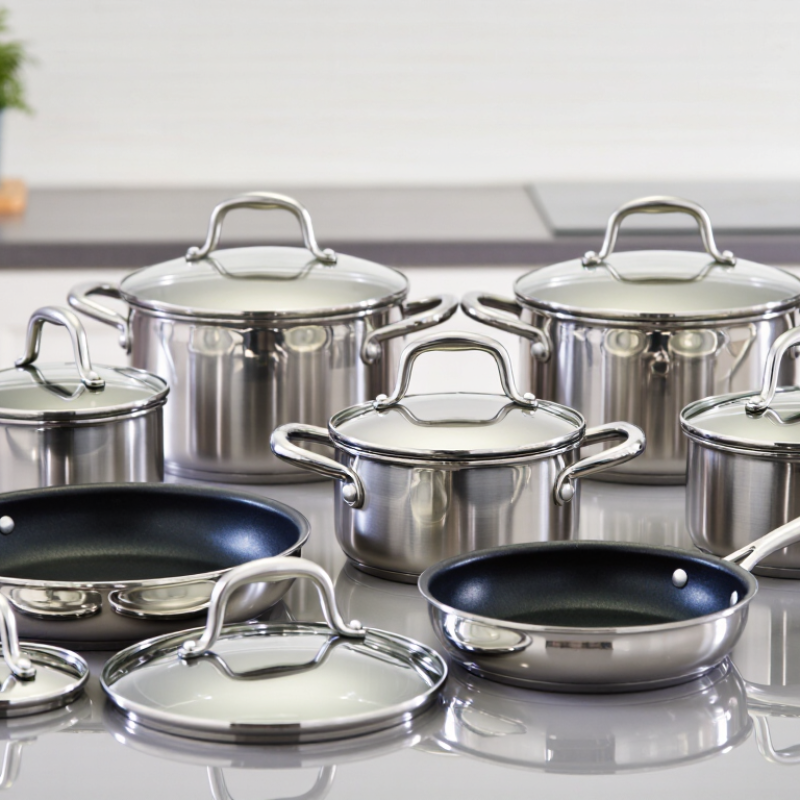
What Stainless Non-Stick Cookware Is and How It Is Made
Stainless non-stick cookware combines a stainless steel body with a food-release surface. The steel provides structure and handles everyday heat, while the coating helps food lift away with less sticking. These are separate materials working together, not a single “non-stick steel” surface. Construction varies by product, so details such as the base thickness and coating system matter.
Manufacturing usually begins with forming and polishing the steel body. Workers clean and prepare the cooking surface so the coating can adhere more evenly. One or more coating layers may then be applied and cured under controlled heat. The finished pans are checked for visible defects, surface consistency, and dimensional accuracy. Small process differences can affect durability. Still, no coating lasts forever, and performance depends partly on use and care.
Tips: Heat gradually, use moderate settings, and choose utensils that will not scratch the surface. Let the pan cool before washing. Check the maker’s care instructions, since coating types and oven limits can differ. A little caution helps.
China Top 10 Stainless Non-Stick Cookware Manufacturers – What Stainless Non-Stick Cookware Is and How It Is Made
Stainless non-stick cookware combines a stainless-steel cooking surface or exterior with a non-stick coating. Many pans use an aluminum core or layer to help distribute heat. This chart compares approximate thermal conductivity at room temperature: copper and aluminum conduct heat more readily than common stainless steel. Actual values vary by alloy and product construction.
Key Standards for Evaluating Chinese Cookware Manufacturers
A cookware manufacturer’s claims matter less than the evidence behind them. Ask how it verifies stainless-steel grade, body thickness, and handle attachment. Reliable suppliers should provide material records and explain how they inspect incoming steel. A sample can reveal uneven rims, loose handles, or a lid that rocks. Small flaws matter.
For non-stick cookware, request coating specifications and relevant food-contact test reports for your intended market. Ask how each production batch is checked for coating coverage, adhesion, and surface defects. A clear answer should describe the test method, not just promise “high quality.” Also review production consistency: compare samples from different batches, check packaging protection, and confirm how defects are handled. Some factories may have strong equipment but weak documentation. That deserves a closer look.
Tips: Send the same questions to every shortlisted supplier. Request dated reports, a factory audit, and a pilot order before scaling up. Check whether the cookware heats evenly on your target cooktops. Keep written records of agreed specifications. Don’t rely on photos alone.
Profiles of Ten Leading Stainless Non-Stick Cookware Manufacturers in China
China’s stainless non-stick cookware sector includes manufacturers with distinct production strengths. These ten profile types help buyers compare capabilities without relying on marketing claims. One focuses on stamped stainless-steel bodies for everyday pans. Another specializes in bonded bases designed for more even heating. A third produces lightweight cookware with compact handles. A fourth offers thicker-gauge pots for frequent use. A fifth concentrates on consistent coating application and smooth release.
Other manufacturers stand out for different reasons. One supports custom dimensions and finishes for private-label orders. Another supplies cookware sets with coordinated lids and utensils. A factory with automated polishing may deliver more uniform surfaces. A smaller workshop may handle flexible, lower-volume runs, though its output capacity needs checking. A testing-focused producer can document coating adhesion, handle strength, and heat distribution. Not every polished sample tells the whole story. Production consistency matters.
Tips: Request a recent production sample, material specifications, and inspection records. Ask how the maker checks coating thickness and cookware flatness. Confirm whether the quoted price includes lids, packaging, and agreed tests. Small details matter. A clear process is useful, but buyers should still verify performance independently.
Product Ranges, Production Capabilities, and Export Markets
When comparing China’s top 10 stainless non-stick cookware manufacturers, look beyond catalog photos. Product ranges may include frying pans, saucepans, stockpots, and coordinated sets. Check whether each item suits gas, electric, or induction cooktops. Stainless steel grade, body thickness, handle attachment, and coating options affect daily use. A heavier base can spread heat more evenly, but it may also make a pan harder to lift. Details matter.
Production capability is more than factory size. Ask how suppliers control steel forming, base bonding, coating application, and final inspection. Useful checks include coating adhesion, handle strength, flatness, and batch-to-batch consistency. Request current test records and sample cookware before discussing large orders. A smooth sample is encouraging, not proof that every production run will match it. Export experience can help with packaging, labeling, and shipment planning across different markets, but confirm that the supplier has handled products similar to yours.
Tips: Compare samples using the same heat source and cooking test. Ask for written specifications, inspection steps, and realistic lead times. Ask for evidence.
China Top 10 Stainless Non Stick Cookware Manufacturers - Product Ranges, Production Capabilities, and Export Markets
Anonymous, non-ranked industry profiles. The entries describe common cookware product and manufacturing capabilities in China, not verified specifications of ten individual companies. Factory capacity and customer-specific export destinations are not consistently disclosed and should be confirmed directly with suppliers.
| Anonymous profile | Typical product range | Materials and construction | Typical production capabilities | Export-market context |
|---|---|---|---|---|
| Profile 1 — Core stainless cookware | Saucepans, stockpots, frying pans, sauté pans, and cookware sets. | Stainless-steel bodies; nonstick interiors may be offered as a product option. | Common operations include metal forming, handle attachment, surface finishing, coating, and assembly. Exact equipment and output are factory-specific. | North America, Europe, and other destinations are served by Chinese cookware exporters; individual supplier coverage varies. |
| Profile 2 — Induction-ready cookware | Induction-compatible pots, pans, and multi-piece sets. | Typically uses a magnetic stainless-steel base or a compatible layered base construction; compatibility depends on the finished product. | May include base forming or bonding, cookware forming, coating, and induction-compatibility checks. | Induction-ready products are relevant to markets where induction cooktops are sold; destination and sales volume are supplier-specific. |
| Profile 3 — Multi-layer construction | Clad or layered frying pans, saucepans, and stockpots, with nonstick versions available from some suppliers. | Layered constructions may combine stainless steel with an aluminum heat-spreading layer; layer design varies by model. | Production can involve layer bonding, forming, edge finishing, handle assembly, and optional coating operations. | Export suitability depends on product specifications, buyer requirements, and applicable market regulations. |
| Profile 4 — Press-formed cookware | Stamped frying pans, shallow casseroles, and lightweight cookware sets. | Formed stainless-steel bodies with model-dependent thickness and finish; nonstick coating may be applied to the cooking surface. | Press forming, trimming, polishing, coating, and assembly are common process steps. Available tooling depends on the factory. | Chinese-made pressed cookware is offered for domestic and overseas buyers; specific markets require supplier confirmation. |
| Profile 5 — Deep-drawn cookware | Deeper saucepans, milk pans, pots, and selected wok-style products. | Stainless-steel bodies made to product-specific shapes; nonstick interiors are an optional specification, not a universal feature. | Deep drawing and subsequent trimming, finishing, handle fitting, and inspection may be used; achievable dimensions depend on tooling and material. | Potential buyers include importers, retailers, and foodservice distributors in multiple regions; actual customer markets are not public for every factory. |
| Profile 6 — Coating-focused cookware | Stainless-steel frying pans and sets with nonstick cooking surfaces. | Stainless-steel substrate with a specified nonstick coating system. Coating type, layers, and care instructions vary by model. | Surface preparation, coating application, curing, and coating inspection may be performed in-house or through qualified subcontractors. | Exporters must meet the destination market's applicable product-safety, chemical, labeling, and documentation requirements. |
| Profile 7 — OEM and private-label production | Buyer-specified pans, pots, sets, packaging, and accessory combinations. | Material grade, body construction, coating, finish, and handle design are generally defined by the product specification. | May support sampling, tooling coordination, customized packaging, and production inspection; minimum orders and lead times are quote-specific. | Markets are determined by the buyer's distribution plan and required certifications or compliance documentation. |
| Profile 8 — Gift-set and retail-packaging production | Coordinated cookware sets, lid-and-pan combinations, and retail-ready gift packs. | Product materials and finishes vary across a set; stainless-steel bodies may be paired with glass lids or other specified components. | Set assembly, component matching, packaging, and shipment preparation can be part of the service; packaging options are buyer-specific. | Retail packaging and labeling need to be adapted to the intended market and purchaser requirements. |
| Profile 9 — Foodservice-oriented cookware | Larger pots, saucepans, frying pans, and selected commercial-kitchen items. | Stainless-steel construction is common; nonstick suitability depends on the intended use and buyer specification. | Products may be made in commercial sizes using forming, finishing, and assembly operations; commercial-use durability should be validated by testing. | Potential channels include foodservice distributors and hospitality suppliers. Specific export relationships are not assumed. |
| Profile 10 — Mixed-range cookware supplier | A combination of stainless-steel cookware, nonstick pans, lids, utensils, and bundled sets. | Material and construction vary by product; each SKU should be checked against its technical specification. | May combine in-house processes with sourced components or subcontracted operations. The scope of factory production should be verified during supplier qualification. | A broad catalog can serve different overseas channels, but actual export destinations and order history require documentary verification. |
Note: “Top 10” is retained in the requested heading only; the anonymous profiles are illustrative and are not a verified ranking. Request factory-specific capacity, product test reports, material specifications, and export references before purchasing.
How to Compare Manufacturers and Choose a Suitable Supplier
When comparing stainless non-stick cookware manufacturers in China, look beyond the quoted unit price. Start with construction details: steel grade, body thickness, base design, and handle attachment. Ask whether the non-stick layer is applied in-house or by a qualified partner, and how adhesion and abrasion are checked. Request current material and food-contact documents relevant to your sales market, then confirm their scope and dates. Ask for evidence. Request a production sample, not just a display piece. Check heat distribution, pan balance, coating consistency, and whether the handle remains secure after repeated use.
A reliable supplier should explain its inspection steps and share recent batch records or sample reports. Ask how defects are recorded, what happens when a batch misses agreed limits, and who covers replacement freight. Compare normal and peak-season lead times in writing. Discuss packaging, spare-part availability, and whether custom dimensions change tooling costs or minimum order quantities. Price is not everything. A polished catalog can still hide uneven production, and an audit cannot guarantee every shipment. Keep a written specification with photos, tolerances, test methods, and approved samples before placing a larger order.
Article Source:


Fall into Function: How LaFata Cabinets Prepares Your Kitchen for the Cozy Season


Back-to-School Kitchen Refresh: How LaFata Cabinets Can Help You Stay Organized This Fall


