
How to Choose the Best Dinosaur Puppet Supplier
Choosing a Dinosaur Puppet supplier is not just a price comparison. The right partner should deliver a puppet that feels lively in a child’s hand, looks consistent across orders, and arrives with clear material and production details. Grand View Research estimated the global toys market at USD 108.3 billion in 2024 and projected continued growth through 2030. This broad market estimate is useful context, not proof of demand for dinosaur puppets specifically. Still, it highlights why buyers should assess suppliers carefully in a crowded category.
A strong evaluation starts with the sample. Check the stitching around the jaw, the puppet’s weight, the texture of its fabric, and whether its mouth moves smoothly. Ask how colors, dimensions, packaging, and order quantities are controlled between samples and production runs. Request relevant toy-safety test documentation for the intended market, and confirm who performs the testing. Details matter. A glossy sample can mislead. I have seen buyers focus on artwork while overlooking hand comfort and seam quality; those choices can become costly once products reach customers. No supplier can remove every risk. The goal is to ask specific questions, verify the answers, and compare like with like. This guide explains how to assess product quality, communication, customization, production capacity, and total cost before choosing a Dinosaur Puppet supplier.
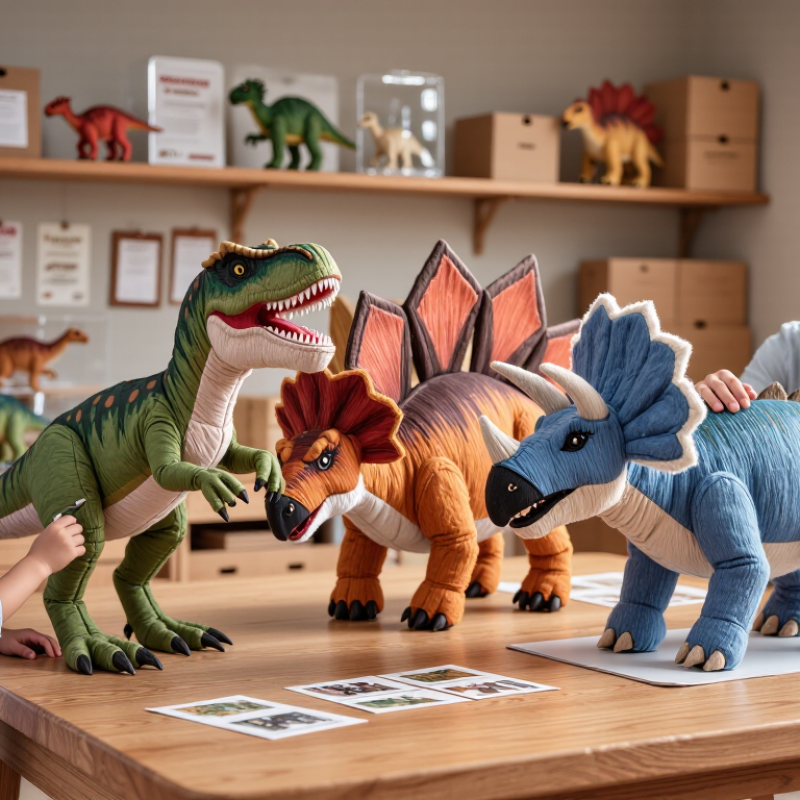
Define the Puppet’s Intended Use and Requirements
Before contacting a dinosaur puppet supplier, define where and how the puppet will be used. A classroom puppet needs a lightweight body, a wide viewing angle, and controls that a teacher can operate while speaking. A stage puppet may need stronger seams, a larger silhouette, and colors that remain visible under bright lights. For close-up demonstrations, realistic texture matters more than size. Specify the operator’s hand size, expected daily use, storage conditions, and whether children will handle the puppet. Small details count.
Safety and durability should match the actual audience. The U.S. Consumer Product Safety Commission’s 2023 toy-related injury report estimated 231,700 emergency department-treated injuries involving toys; the figure covers toys broadly, not dinosaur puppets specifically. It is a useful reminder to ask suppliers about age grading, detachable parts, material composition, seam strength, and applicable toy-safety testing. Request clear specifications and test documentation, not just verbal assurances. Also describe cleaning needs: a puppet used in a busy classroom may need wipeable materials, while plush fabric can be harder to maintain. A common planning mistake is asking for “high quality” without defining what that means. I would revise that brief before requesting quotes. A short video showing the intended movements can help suppliers judge mouth range and arm access. Then compare samples against those requirements, in real use.
Compare Product Quality and Customization Options
When comparing dinosaur puppet suppliers, inspect more than the photos. Ask for close-ups of the seams, teeth, eyes, and joints. Check whether the fabric feels sturdy and whether the puppet moves smoothly without straining the operator’s hand. Small details matter. Request a sample if possible, then use it for several minutes. Look for loose threads, stiff jaws, or paint that rubs off. A neat display sample is not always a durable working puppet.
Customization should be specific, not just “made to order.” Ask what can change: dinosaur species, colors, size, mouth movement, fabric, or printed details. Share a simple drawing or reference images, and request a written list of agreed features. Ask to see a prototype before full production. I have learned that a vivid color on a screen may look quite different on textured fabric. That part is easy to overlook.
Compare suppliers on how clearly they explain materials, construction, sample approval, and production timing. Ask how they check finished puppets and what happens if a feature differs from the approved sample. A supplier who answers with practical details is easier to evaluate than one who promises everything. I would still leave room for small variations, especially in handmade details, and confirm which differences are acceptable before placing an order.
Check Materials, Safety Standards, and Craftsmanship
When comparing dinosaur puppet suppliers, inspect the materials, not just product photos. Ask for fabric composition, colorfastness results, filling details, and cleaning instructions. Rub a damp white cloth across the scales and belly; visible dye transfer deserves follow-up. Check stitching around the jaw, claws, and hand opening, where repeated movement can stress seams. Eyes and decorative spikes should stay firmly attached during a careful pull test. A certificate alone is not the puppet.
Safety paperwork should match the product’s intended age group and sales market. For products sold in the United States, ask whether testing covers applicable ASTM F963 requirements. Request reports that identify the tested model and materials, rather than accepting a generic certificate. The U.S. Consumer Product Safety Commission’s 2023 Toy-Related Deaths and Injuries report estimated 231,700 toy-related emergency-department injuries that year. The figure covers toys broadly, not puppets specifically, but it shows why small parts and construction deserve attention. Still, paperwork cannot reveal every weak seam.
Craftsmanship shows in details: even stitches, smooth edges, securely finished fabric, and a mouth that moves without catching. Ask how the puppet is cleaned and whether repeated hand movement has been assessed. A strong sample may not represent every production batch, so request quality-check procedures too. That step is easy to miss. A slightly uneven seam is not automatically unsafe, but it should prompt a closer look.
How to Choose the Best Dinosaur Puppet Supplier - Check Materials, Safety Standards, and Craftsmanship
| Evaluation area | What to check | Evidence to request | Assessment guide |
|---|---|---|---|
| Material details | Confirm the fabric, filling, lining, and any coatings or surface finishes. Check that materials suit the intended age group and use. | Written material specifications and a sample matching the proposed production materials. | Strong: specifications are complete and consistent with the sample. Caution: material descriptions are vague or change without notice. |
| Applicable safety requirements | Identify the sales market, intended age, and whether the puppet is treated as a toy. Requirements depend on product design and market. | A written compliance plan that identifies applicable rules and standards for the specific product and destination market. | Strong: the supplier can explain which requirements apply and why. Caution: one generic certificate is offered for every market and product. |
| United States toy safety | For products classified as toys, check relevant requirements, which may include ASTM F963 and applicable Consumer Product Safety Improvement Act (CPSIA) rules. | Applicable test reports and required children’s product documentation. Ask whether testing covers the exact materials, age grade, and finished product. | Strong: documentation is traceable to the product and current construction. Caution: reports refer to different materials or a different product. |
| European Union toy safety | If the product is marketed as a toy in the EU, check applicable toy-safety obligations, including relevant EN 71 requirements and chemical restrictions where applicable. | Relevant test documentation and the information needed for the responsible economic operator’s conformity assessment and declaration. | Strong: documents match the product and intended use. Note: CE marking is associated with the manufacturer’s conformity obligations; it is not, by itself, proof of independent testing. |
| Small parts and attachments | Inspect eyes, teeth, claws, buttons, and other attached components. Consider detachment, choking, and sharp-edge risks, especially for products intended for young children. | Construction details, age-grading rationale, and applicable test results for the finished product. | Strong: attachments are secure and risks are assessed for the intended age. Caution: small decorative parts are added without review. |
| Seams and stitching | Check seam consistency, reinforced stress points, loose threads, exposed edges, and whether repeated handling causes seams to open. | A production sample and the supplier’s inspection criteria for seams and workmanship. | Strong: seams are even and stress points are reinforced. Caution: visible gaps, loose stitching, or inconsistent finishing. |
| Shape, fit, and operation | Check that the puppet fits the intended hand size, opens and closes smoothly, and keeps its shape during ordinary use. | A sample for hands-on evaluation, plus agreed dimensions and tolerances for production. | Strong: comfortable movement and consistent dimensions. Caution: restricted movement or noticeable sample-to-sample variation. |
| Color and surface finish | Look for even coloring, securely applied details, and surfaces without unexplained residue, strong odors, or peeling finishes. | Approved color reference, sample, and relevant chemical or material test documentation when required. | Strong: appearance is consistent and finishes remain intact in normal handling. Caution: flaking, staining, or undocumented coatings. |
| Quality control and traceability | Ask how incoming materials, in-process work, and finished products are checked, and how production lots can be identified. | Written inspection steps, defect criteria, and a sample lot or batch identification record. | Strong: checks and lot records are clearly documented. Caution: quality claims are not supported by a defined process. |
| Overall supplier decision | Compare the sample, documentation, communication, and ability to keep production consistent against your product requirements. | Keep a written record of sample approval, specifications, applicable compliance documents, and agreed quality checks. | Choose based on verifiable evidence and product fit, not on price or unsupported safety claims alone. |
Note: This checklist is for supplier evaluation and does not replace a product-specific compliance assessment. Requirements can vary by market, product classification, design, and intended age.
Review Pricing, Minimum Orders, and Delivery Terms
Compare the full delivered cost, not just the price per dinosaur puppet. Ask for an itemized quote covering sample fees, customization, packaging, and shipping. A low unit price may depend on a large order or exclude protective packaging. For puppets with moving jaws or detailed fabric features, check whether the quoted price includes the exact design you approved. Small details matter. Request a written quote with a validity date, since material and freight costs can change.
Minimum order quantities affect both budget and storage. Ask whether the supplier can provide a smaller first run, mixed designs, or a paid sample before production. Calculate the cost per usable puppet, not merely per unit ordered; a bargain is less attractive if unsold stock fills a closet. That adds up. It is easy to focus too much on the lowest threshold, though a larger order may sometimes reduce unit costs. Compare both options against realistic demand.
Delivery terms should state the production timeline, shipping method, estimated transit time, and who pays for freight. Ask when the clock starts: after deposit, sample approval, or final artwork confirmation. Request milestone updates and a plan for delays or damaged cartons. Build in slack. A promised arrival date is not a guarantee, and school events or seasonal sales leave little room for mistakes. Keep the agreed dates and responsibilities in writing before paying.
Assess Supplier Reliability and After-Sales Support
A reliable dinosaur puppet supplier should explain how it handles delays, repairs, and replacement parts before you place an order. Ask for a written service policy, not just a friendly assurance. Small details matter: who answers support emails, expected reply times, and whether hand stitching or moving jaws can be repaired locally. Keep a copy.
Check reliability through recent customer references and clear production records. Request photos or a short video of the exact puppet, including seams, eye attachments, and mouth movement. Ask what happens if the delivered item differs from approved specifications. Vague replies are a warning. A polished website is not proof of dependable service; it is easy to trust appearances too quickly.
After-sales support matters for puppets used in classrooms, performances, or touring shows. Confirm how to clean the fabric, store the mechanism, and report a defect. Ask whether guidance, spare components, or repair assessments are available, and how shipping damage is documented. Put timelines in writing. No supplier can prevent every problem. A useful partner responds clearly when one appears. Even then, inspect the puppet on arrival; I would not skip that step.
Article Source:


Fall into Function: How LaFata Cabinets Prepares Your Kitchen for the Cozy Season


Back-to-School Kitchen Refresh: How LaFata Cabinets Can Help You Stay Organized This Fall


