
top of page

How to Choose the Best Metal Cutting Board?

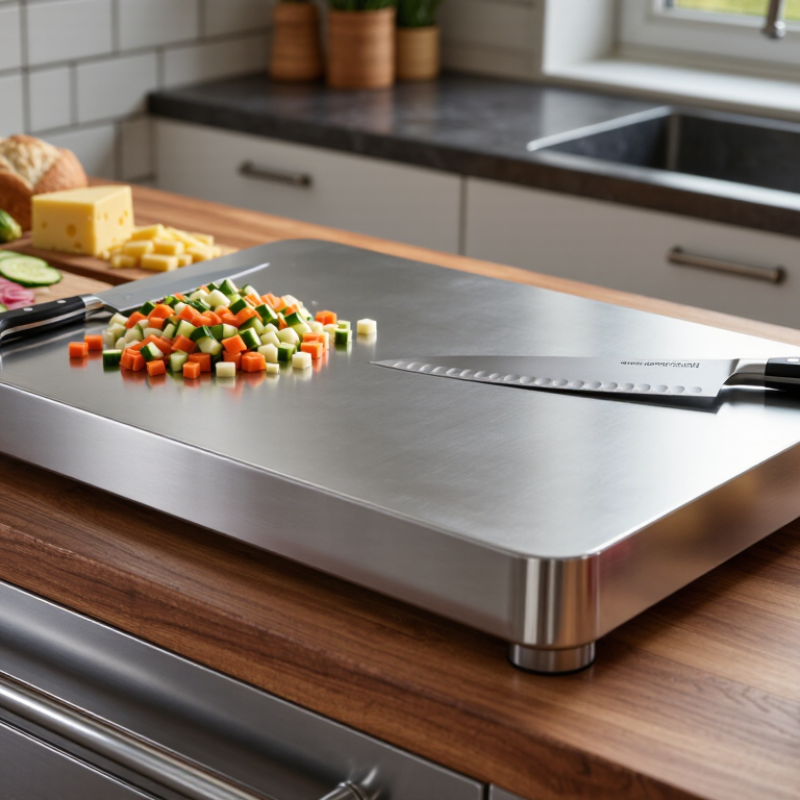
Choosing the best Metal Cutting Board involves more than comparing prices or polished finishes. Stainless steel resists stains and odors, and its smooth surface is usually straightforward to clean. But it is also hard on knife edges. That trade-off matters. A board that looks durable may still feel slippery or noisy during routine chopping.

This guide looks at practical details: metal grade, thickness, surface finish, stability, and ease of cleaning. Check the manufacturer’s specifications rather than relying on appearance alone. Rounded edges, a flat base, and secure non-slip feet can make a board more comfortable to handle. For food preparation, follow the maker’s cleaning instructions and avoid assuming every board is suitable for every task. Some products are designed for serving or specific uses, not constant knife work.

Think about what you cut most often. Soft foods may be manageable, while frequent chopping can wear knives faster on a hard metal surface. Small details count. A little noise can become annoying. There is no perfect choice, and the trade-off is easy to underestimate when shopping online. This article will help you compare features, weigh everyday convenience against knife care, and decide whether a metal board fits your kitchen.
How to Choose the Best Metal Cutting Board?

Define Intended Use and Board Size Around Prep Volume and Counter Space

Choose a metal board by matching its job to your daily prep, not by buying the largest surface available. The 2023 U.S. Bureau of Labor Statistics American Time Use Survey found that 83% of women and 64% of men did household activities on an average day. That broad measure includes more than cooking, so it cannot predict your chopping volume. Still, frequent meal prep makes a stable, easy-to-clean work area more useful. A metal surface is hard on knife edges; don’t assume it should replace every wood or plastic board. Check that its intended use suits your tools and ingredients.

Measure your clear counter area before choosing a board. Leave space beside it for a bowl, a knife, and a small pile of scraps. For a quick breakfast or occasional garnish, a compact board may be enough. Batch-cooking vegetables or portioning several ingredients calls for more working room, but an oversized board can crowd the sink and hob. The FDA Food Code 2022 says food-contact surfaces should be durable, nonabsorbent, smooth, and easily cleanable. Those are useful checks, not a guarantee that every metal board is suitable for every task. I would measure twice; counter space is easy to misjudge. A board that fits your busiest realistic prep session is usually more practical than one chosen for an imagined feast.

How to Choose the Best Metal Cutting Board? — Define Intended Use and Board Size Around Prep Volume and Counter Space

Intended Use Suggested Board Size Board Footprint Typical Prep Volume Counter Space to Allow Selection Considerations
Occasional, small tasks 12 × 8 in (30 × 20 cm) 96 sq in (about 619 cm²) One or two ingredients, such as a lemon, herbs, or a small portion of vegetables At least 16 × 12 in (41 × 30 cm), allowing roughly 2 in (5 cm) around the board Easy to fit in a compact kitchen, but limited room for collecting chopped food or keeping ingredients separate.
Everyday, light meal prep 15 × 10 in (38 × 25 cm) 150 sq in (about 968 cm²) A few vegetables or ingredients for one to two portions At least 19 × 14 in (48 × 36 cm) A practical choice where counter space is limited. Check that the board stays stable and does not overhang the work surface.
Regular family meal prep 18 × 12 in (46 × 30 cm) 216 sq in (about 1,394 cm²) Several ingredients for a family meal, with room to stage chopped items At least 22 × 16 in (56 × 41 cm) A versatile size for many kitchens. Measure the usable counter area, including nearby sink and appliance clearance.
High-volume or batch prep 20 × 14 in (51 × 36 cm) 280 sq in (about 1,806 cm²) Multiple vegetables or larger quantities prepared in one session At least 24 × 18 in (61 × 46 cm) Provides a larger working area, but is heavier and takes up more storage space. Confirm that it can be lifted and cleaned comfortably.
Large-format prep on a spacious counter 24 × 18 in (61 × 46 cm) 432 sq in (about 2,787 cm²) Large batches or bulky ingredients that need extra staging room At least 28 × 22 in (71 × 56 cm) Choose only if the counter can support the full board securely and you have adequate sink and storage space for handling it.

Before buying: Measure the flat, usable counter area and compare it with the board footprint; leave working clearance around the edges where possible. Use a food-contact-safe metal surface and follow its cleaning instructions. Metal is hard on knife edges and can feel slippery or noisy, so it is generally better suited to tasks such as dough work or setting down ingredients than frequent chopping with sharp knives.

Verify Food-Grade Steel: Type 304 Typically Contains 18% Chromium and 8% Nickel

A metal cutting board can look clean and sturdy, but appearance does not identify its alloy. For food contact, ask for the exact steel grade and supporting material documentation. Type 304 typically contains about 18% chromium and 8% nickel. These are nominal figures, not a promise that every sample has precisely that composition. Chromium helps resist corrosion; nickel contributes to toughness and corrosion resistance.

A supplier’s grade statement or material certificate is more useful than a vague “food-grade” label. Check that the document identifies 304 and lists its chemical composition; a traceable test report adds confidence. Also inspect the board’s surface. Deep scratches, rough seams, and damaged coatings can hold residue. A smooth finish matters. Still, steel can dull knives faster than wood or plastic, so consider whether frequent sharpening suits your kitchen.

Tips: Ask for documentation before buying. Verify any grade stamp against the paperwork, not by color or shine. Wash and dry the board after use, especially around seams. If the seller cannot explain the steel grade, pause. I would, too; a clear answer is worth more than polished product wording.

Check Steel Documentation Against ASTM A240 Sheet and Plate Specifications

How to Choose the Best Metal Cutting Board?

Check Steel Documentation Against ASTM A240 Sheet and Plate Specifications

Do not judge a metal cutting board by its shine alone. Ask for the material test report, then match its grade and heat number to the product paperwork. ASTM A240/A240M covers stainless steel plate, sheet, and strip, with requirements for chemical composition and mechanical properties. It does not certify a finished board as safe, hygienic, or suitable for every kitchen. Details matter.

Check that the report identifies the steel grade, thickness, and applicable ASTM A240/A240M edition. Look for traceable heat numbers and recorded test results, not just a generic claim of “stainless steel.” A certificate can still leave questions. Ask separately about surface finish, edge treatment, and flatness; these features affect cleaning and daily handling, but are not proof of board performance under every use. I would not rely on paperwork alone.

Tips: Compare the report with the actual board label. Check for dents, sharp edges, and uneven corners. If the supplier cannot connect the board to its steel documentation, pause before buying. A small mismatch is worth investigating.

Assess Cleanability Under FDA 21 CFR 117.40 Food-Contact Equipment Requirements

When choosing a metal cutting board, assess how easily its food-contact surfaces can be cleaned. FDA 21 CFR 117.40 requires food equipment to be adequately cleanable and maintained in a way that prevents contamination. It also addresses corrosion-resistant, nontoxic materials and seams that limit food buildup. A metal surface alone does not establish compliance.

Look closely at corners, joints, fasteners, and any recessed areas. Could a cloth reach them? Can water drain instead of pooling? After cutting oily food, residue should not remain in scratches or seams. The finish should tolerate the cleaning methods intended for the board without flaking or corroding. Ask for care instructions, then check whether they fit your actual washing routine. That detail matters.

A smooth appearance can be misleading. Inspect the board after repeated use, especially for deep cuts, rough edges, discoloration, or loosened parts. These can make cleaning harder, even when the board looked suitable when new. I would not assume every metal board is easy to sanitize just because it is nonporous. Cleanability depends on its design, condition, installation, and maintenance. Keep a simple inspection record, and replace or repair a board when damage cannot be cleaned effectively.

Compare Knife Wear, Board Thickness, and Grip for Safe, Stable Cutting

A metal cutting board feels rigid and easy to wipe clean, but that hardness comes at a cost. Repeated contact can dull a knife edge faster than wood or plastic, especially when chopping with force.

You may notice the blade losing its bite sooner. For frequent slicing, choose a softer board; metal is better suited to tasks where toughness and quick cleanup matter more than edge retention.

Knife steel and cutting technique also affect wear, so the board is only part of the picture.

Thickness affects both stability and handling. A very thin sheet may flex, rattle, or slide when you press down, while a heavy slab can be awkward to lift and wash.

Look for a board that sits flat and feels solid without being cumbersome. Grip is just as important. Non-slip feet or a secure base can help prevent movement on a dry counter, but check that the board stays steady when pushed from different angles.

Keep the counter and contact points clean and dry. Small details matter.

I would still test the board gently before chopping; grip claims do not guarantee a stable surface in every kitchen.

S O C I A L 

  • Facebook
  • Instagram
  • Pinterest

©2022 by LaFata Cabinets. Proudly created with Wix.com

bottom of page