
Top Types of Cup Paper Sheets for Global Buyers
Paper cups may look uniform on a café counter, but their performance starts with the sheet beneath the print. Cup Paper Sheet selection affects forming, sealing, stiffness, and resistance to hot liquids. For global buyers, the key choices include polyethylene-coated board, dispersion-coated paper, and other barrier-treated grades. Each option brings different converting requirements and end-use characteristics.
Market growth makes these choices more important. Grand View Research estimated the global paper cups market at about USD 10.1 billion in 2023, with projected growth through 2030. This figure describes finished cups, not demand for any specific paper-sheet grade. Still, it signals a large, active market where material consistency matters. Small differences can show up at the factory: a weak seal, a soft rim, or a sheet that feeds poorly on a forming line. Details count.
This guide compares common cup paper sheet types by coating, basis weight, barrier performance, printability, and converting needs. Buyers should also request current technical data sheets and samples for machine trials. A specification that works for one cup size or filling temperature may not suit another. That sounds obvious, perhaps, but it is easy to overlook when comparing prices alone. Coatings and claims should be checked against the buyer’s intended use and applicable market requirements. The right choice is not always the most expensive one; it is the grade that performs reliably in the actual production setup.
What Cup Paper Sheets Are and How They Are Made
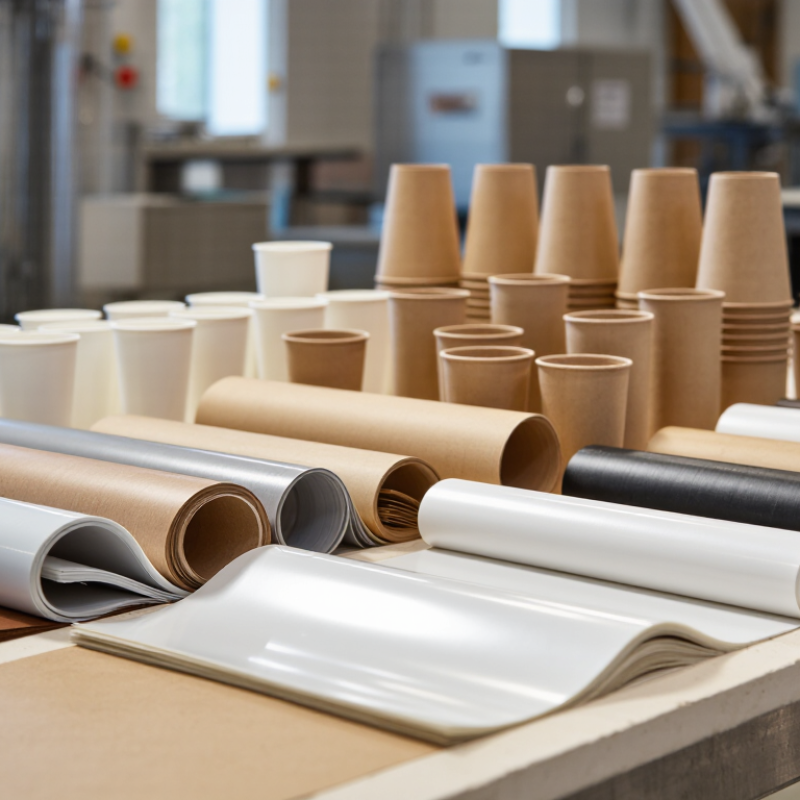
Cup paper sheets are flat, food-packaging paperboard designed to be cut and shaped into disposable cups. They are not ordinary printing paper: the board needs enough stiffness to hold its shape, yet it must fold cleanly at the cup’s side seam and base. Not a finished cup. The sheet is a material ready for converting, not a container on its own.
Production usually starts with wood pulp or other suitable paper fibers mixed with water and formed into a continuous web. Pressing and drying remove moisture and build strength. The board may then receive a thin barrier layer, such as a polymer coating or a purpose-designed dispersion coating, to help limit liquid absorption. The exact structure depends on the intended drink, storage conditions, and converting equipment. After coating, large rolls are inspected and slit or cut into sheets of specified sizes.
Small details matter. Uneven coating can leave weak spots, while moisture changes may affect how neatly a sheet feeds through a cup-forming machine. In practice, a sheet that looks smooth can still behave differently during folding. Buyers can ask for thickness, stiffness, coating details, and food-contact documentation, then test samples on their own equipment. Specifications help, but they do not replace a production trial.
Top Types of Cup Paper Sheets for Global Buyers — What Cup Paper Sheets Are and How They Are Made
Cup paper sheets are flat paperboard stock or pre-cut blanks used to manufacture paper cups. The specifications below are indicative industry ranges; actual requirements vary by cup design, filling temperature, converting equipment, and applicable food-contact regulations.
| Sheet Type | Typical Construction | Common Applications | Key Properties | How It Is Made |
|---|---|---|---|---|
| Single-side PE-coated cupstock | Paperboard commonly around 170–350 g/m², with a polyethylene (PE) layer on one side. Coating weight is selected for the cup design and performance requirements. | Cold-drink cups and many hot-drink cups where a conventional plastic moisture barrier is suitable. | Provides a liquid barrier on the coated side and can be heat-sealed during cup forming. The uncoated side is typically used as the printable outer surface. | Paperboard is produced, surface-treated or printed as needed, extrusion-coated with PE, then supplied in reels or converted into cup blanks. |
| Double-side PE-coated cupstock | Paperboard with PE coating on both sides; total basis weight depends on the board and coating layers. | Applications needing added resistance to moisture on both the inside and outside, including some chilled or condensation-prone uses. | Both surfaces have a moisture barrier. Printing and sealing performance depend on coating formulation and converting conditions. | Both faces are extrusion-coated, either in separate coating stages or through an integrated process, before the material is wound or sheeted. |
| PLA-coated cupstock | Paperboard laminated or extrusion-coated with polylactic acid (PLA), a bio-based polymer. Board and coating weights vary by specification. | Paper cups designed for systems that accept PLA-coated packaging and have suitable collection or processing infrastructure. | Provides a liquid barrier and heat-sealable surface. Bio-based content does not by itself mean the cup is home-compostable or recyclable in every location. | Paperboard is coated with PLA, then printed, die-cut, and converted. End-of-life claims should be checked against local certification and waste-processing options. |
| Dispersion-barrier cupstock | Paperboard treated with a water-based barrier dispersion rather than a conventional extruded polymer film. | Selected cup formats where barrier performance and compatibility with available paper-recycling processes are key considerations. | Barrier performance depends on the coating system, cup construction, and intended contents. Recyclability should be verified for the finished cup and local facilities. | A formulated dispersion is applied to the paper surface by a coating process, dried, and finished for printing and cup conversion. |
| Uncoated cupstock | Food-contact-suitable paperboard without a separate polymer barrier layer. | Dry-food containers and specialty cup designs where the contents and construction do not require a conventional liquid barrier. | Paperboard surface and stiffness can support printing and forming, but uncoated stock alone is generally not suitable for holding liquids for extended periods. | Paperboard is manufactured and finished to the required strength and surface quality, then printed and cut or supplied for further cup conversion. |
| Pre-cut cup fan blanks | Fan-shaped, die-cut pieces made from cupstock; each blank forms the tapered sidewall of a cup. | Converted into cup bodies on paper-cup forming machines. | Blank dimensions, grain direction, edge quality, and coating orientation must match the cup design and forming equipment. | Printed or unprinted cupstock is fed through a die-cutting process. The blanks are stacked and later curled, side-seamed, and joined to a bottom disc. |
| Bottom-disc blanks | Round or shaped discs cut from compatible cupstock, often with a barrier layer suited to the cup construction. | Bottom panels for single-use paper cups and related paper containers. | Disc diameter and material must match the cup wall, sealing method, and required liquid resistance. | Stock is punched or die-cut into discs. During cup forming, the disc is inserted and sealed to the curled lower edge of the sidewall. |
| Typical cup-forming sequence | Printed and barrier-coated cupstock is converted into sidewall blanks and bottom discs. | Manufacture of finished paper cups in a range of sizes and designs. | Performance depends on board stiffness, barrier integrity, seal quality, cup geometry, and quality control. | Print and coat the stock; die-cut the blanks; curl and seal the side seam; attach the bottom disc; curl the rim; then inspect for dimensions, appearance, and leakage. |


